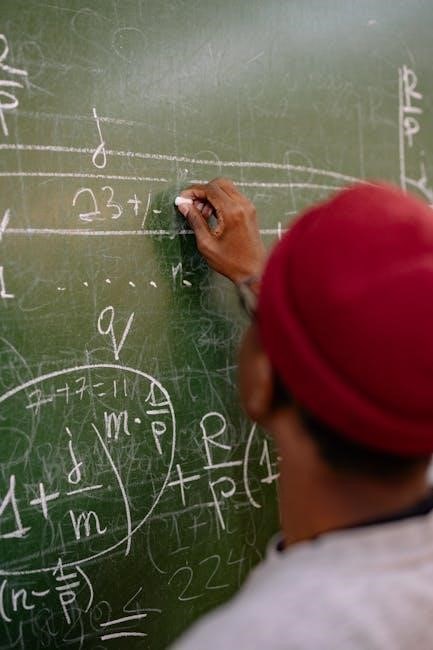
Navigating 3rd grade math requires focused practice! Printable worksheets aligned with Common Core standards offer essential skill reinforcement, covering key concepts like addition and fractions.
What are the Common Core Standards for 3rd Grade Math?
Common Core standards for 3rd grade math build upon prior knowledge, focusing on several critical areas. Students extend their understanding of number and operations, mastering addition and subtraction within 1000, alongside foundational multiplication and division concepts.
Place value to the thousands place is a key component, enabling students to solve more complex problems. Furthermore, the curriculum introduces fractions as numbers, emphasizing understanding equivalence and comparison. Measurement and data skills are developed through length measurement and data interpretation using bar graphs.
Finally, geometry focuses on shapes and their attributes, including partitioning shapes into equal parts. Utilizing practice PDFs helps solidify these concepts, ensuring students meet the rigorous demands of the standards and build a strong mathematical foundation.
Why Use Practice PDFs?
Practice PDFs offer a targeted and efficient way to reinforce 3rd grade Common Core math skills. These resources provide focused exercises, allowing students to master specific concepts like addition, subtraction, fractions, and measurement. The convenience of printable worksheets enables learning anywhere, anytime, supplementing classroom instruction effectively.
PDFs facilitate individualized learning, catering to different paces and needs. They allow for repeated practice, crucial for solidifying understanding and building confidence. Moreover, they offer a cost-effective alternative to expensive workbooks, providing ample opportunities for skill development.
Consistent use of practice PDFs helps students prepare for assessments and fosters a stronger grasp of essential mathematical principles, ultimately leading to greater academic success.

Number & Operations in Base Ten
Mastering place value, addition, subtraction, and rounding within 1000 is key! Practice PDFs build a strong foundation in base-ten concepts for 3rd graders.
Place Value to the Thousands Place
Understanding place value extends to the thousands place in 3rd grade, a crucial step in number sense development. Practice PDFs specifically targeting this skill provide focused exercises for students to identify the value of digits in numbers up to 9999. These resources help solidify comprehension of ones, tens, hundreds, and thousands, enabling students to decompose numbers and represent them in various forms.
Worksheets often include activities like identifying the place value of underlined digits, writing numbers in expanded form, and comparing numbers based on their place value. Consistent practice with these Common Core-aligned materials builds a strong foundation for more complex mathematical operations, ensuring students can confidently work with larger numbers and understand their magnitude.
Addition and Subtraction within 1000
Mastering addition and subtraction within 1000 is a cornerstone of 3rd grade math. Practice PDFs offer a wealth of problems designed to build fluency and accuracy. These resources move beyond basic facts, incorporating multi-digit addition and subtraction with and without regrouping (borrowing and carrying).
Worksheets frequently present problems in both horizontal and vertical formats, encouraging students to apply different strategies. Common Core aligned materials also emphasize problem-solving, presenting word problems that require students to determine whether to add or subtract. Consistent practice with these PDFs strengthens computational skills and prepares students for more advanced arithmetic concepts.
Rounding to the Nearest 10 and 100
Rounding to the nearest 10 and 100 is a crucial skill for estimating and developing number sense in 3rd grade. Practice PDFs provide targeted exercises to help students understand the rules and apply them confidently. These resources typically include number lines to visually demonstrate rounding concepts, aiding comprehension.
Worksheets often present a series of numbers, requiring students to identify the nearest multiple of 10 or 100. Common Core aligned materials emphasize understanding why we round, not just how to do it. Consistent practice with these PDFs builds automaticity and prepares students for more complex rounding scenarios later on.

Operations and Algebraic Thinking
Practice PDFs for 3rd grade focus on multiplication, division, and problem-solving, building a foundation for algebraic thinking through Common Core standards.
Understanding Multiplication
Mastering multiplication in 3rd grade is crucial, and practice PDFs provide targeted exercises to build fluency. These resources emphasize understanding multiplication as repeated addition, utilizing visual models like arrays and number lines. Students learn to represent multiplication problems with equations, connecting concrete experiences to abstract concepts.
Common Core aligned worksheets focus on the relationship between multiplication and division, fostering a deeper comprehension of these interconnected operations. Practice includes solving word problems involving multiplication, encouraging students to apply their knowledge to real-world scenarios. Developing a strong foundation in multiplication is essential for future mathematical success, and these PDFs offer a structured approach to skill development.

Understanding Division
Division, introduced in 3rd grade, builds upon multiplication concepts, and practice PDFs offer focused skill development. These resources emphasize understanding division as sharing equally and finding the unknown factor. Students utilize visual models, like grouping and repeated subtraction, to represent division problems concretely.
Common Core aligned worksheets connect division to multiplication through fact families, reinforcing the inverse relationship between the two operations. Practice includes solving word problems involving division, prompting students to apply their knowledge to practical situations. A solid grasp of division is vital for future math learning, and these PDFs provide a systematic path to mastery.
Properties of Operations (Commutative, Associative, Distributive)
Third grade introduces fundamental properties of operations – commutative, associative, and distributive – laying groundwork for algebraic thinking. Practice PDFs help students grasp these concepts through visual representations and equation-based exercises. The commutative property (order doesn’t matter) is explored with addition and multiplication, while the associative property (grouping doesn’t matter) focuses on addition.
Common Core aligned worksheets utilize number sentences and real-world scenarios to demonstrate these properties. While the distributive property is introduced conceptually, practice focuses on recognizing its application. Mastering these properties enhances number sense and problem-solving skills, preparing students for more advanced mathematical concepts.
Solving Word Problems (Multiplication and Division)
Third grade Common Core standards emphasize applying multiplication and division to solve real-world problems. Practice PDFs are crucial for developing this skill, presenting scenarios requiring students to identify the correct operation. These worksheets move beyond rote memorization, demanding comprehension of the problem’s context.
Students learn to translate words into mathematical equations, utilizing strategies like drawing diagrams or writing number sentences. PDF resources often include multi-step problems, encouraging critical thinking and analytical skills. Mastering word problems builds confidence and demonstrates a practical understanding of multiplication and division, preparing them for future mathematical challenges.

Number & Operations – Fractions
Practice PDFs help 3rd graders grasp fractions as numbers, exploring equivalent forms and comparisons, building a foundational understanding of these crucial concepts.
Understanding Fractions as Numbers
Third grade marks a pivotal shift in understanding fractions – moving beyond simply recognizing parts of a whole to grasping them as numbers themselves. Practice PDFs specifically designed for Common Core alignment are invaluable tools in this process. These resources help students visualize fractions on number lines, reinforcing the concept that a fraction represents a specific quantity.

Worksheets often include exercises where students identify fractions, compare them, and locate them between whole numbers. This builds a strong conceptual foundation. The focus isn’t just on memorization, but on developing a genuine understanding of what a fraction means. PDFs provide repeated exposure, solidifying this understanding through varied problem types and visual representations, ultimately preparing students for more complex fractional operations later on.

Equivalent Fractions
Mastering equivalent fractions is a core 3rd grade Common Core standard, and targeted practice PDFs are crucial for success. These resources move beyond simply identifying equivalent fractions to understanding why they are equal – demonstrating that different fractions can represent the same amount.
Worksheets often utilize visual models like fraction bars and circles, allowing students to visually compare and identify equivalent forms. PDFs provide exercises focused on finding missing numerators or denominators, reinforcing the multiplicative relationship between equivalent fractions. Consistent practice with these materials builds fluency and a deeper conceptual understanding, preparing students for simplifying fractions and more advanced operations in later grades.
Comparing Fractions
Developing the ability to compare fractions is a vital 3rd grade Common Core skill, and dedicated practice PDFs are invaluable. These resources focus on understanding that fractions represent parts of a whole, and comparison depends on the size of those parts.
Worksheets often present fractions with the same denominator, allowing students to easily compare numerators. More challenging PDFs introduce fractions with different denominators, requiring students to find common denominators or use visual models to determine which fraction is larger. Consistent practice builds number sense and prepares students for ordering fractions and applying this skill to real-world problem-solving scenarios.

Measurement & Data
Practice measuring lengths and interpreting data using Common Core aligned PDFs! Worksheets cover units like inches, meters, and bar graphs for analysis.
Measuring Lengths (Units: inches, feet, yards, cm, meters)
Mastering length measurement is crucial in 3rd grade! Practice PDFs focusing on inches, feet, yards, centimeters, and meters provide targeted skill development. These worksheets help students estimate and accurately measure various objects, reinforcing the understanding of different units.
Common Core standards emphasize applying these skills to solve real-world problems. PDF exercises often include comparing lengths, converting between units, and determining appropriate tools for measurement. Students will learn to articulate measurements clearly and understand the relationships between different units of length, building a solid foundation for future mathematical concepts.
Consistent practice with these worksheets ensures students gain confidence and fluency in measuring lengths.
Time, Liquid Volumes, and Masses
Third grade Common Core standards extend to understanding time, liquid volumes, and masses. Practice PDFs offer focused exercises on reading analog and digital clocks, calculating elapsed time, and solving related word problems. These worksheets also cover measuring liquids using units like cups, pints, and quarts, and masses using grams and kilograms.
Students will practice estimating and accurately measuring these quantities, applying their knowledge to practical scenarios. PDF resources often include activities involving time intervals, capacity comparisons, and weight estimations. This builds a strong conceptual understanding of these measurements.
Consistent practice solidifies these skills, preparing students for more complex mathematical applications.
Representing and Interpreting Data (Bar Graphs)
Third grade Common Core standards introduce data representation using bar graphs. Practice PDFs provide ample opportunities to develop skills in creating and interpreting these visual tools. Worksheets focus on reading data from bar graphs, answering questions based on the information presented, and constructing their own graphs from given datasets.
Students learn to identify scales, interpret axes, and compare values represented by different bars. These PDF resources often include real-world scenarios, like surveying classmates or tracking favorite colors, making learning engaging.
Mastering bar graphs builds foundational data analysis skills crucial for future mathematical studies.

Geometry
Practice PDFs for 3rd grade geometry focus on shape attributes and partitioning. Worksheets help students understand shapes and divide them into equal parts effectively.
Understanding Shapes and Their Attributes
Practice PDFs dedicated to shapes and their attributes are crucial for 3rd graders mastering geometry. These worksheets help students identify and describe two-dimensional shapes – triangles, quadrilaterals, pentagons, hexagons, and circles – focusing on defining characteristics like sides and angles.
Students learn to categorize shapes based on these attributes, understanding the differences between squares and rectangles, or identifying whether a shape is a rhombus. Common Core aligned resources emphasize recognizing and drawing shapes with specific attributes, building a foundational understanding for more complex geometric concepts. Effective practice involves classifying shapes, composing shapes, and decomposing shapes.
Partitioning Shapes into Equal Parts
Practice PDFs focusing on partitioning shapes are vital for 3rd graders grasping foundational fraction concepts. These worksheets guide students in dividing shapes into equal parts – halves, thirds, and fourths – visually representing fractions before numerical understanding.
Students learn to identify and create equal shares, understanding that each part represents a unit fraction. Common Core standards emphasize partitioning both two-dimensional and three-dimensional shapes. Effective practice includes shading partitioned shapes, identifying the fraction represented by shaded areas, and partitioning shapes to represent given fractions. This builds a strong conceptual base for future fraction operations.
Resources for Practice PDFs
Numerous online platforms and educational websites provide free and paid Common Core aligned practice PDFs for 3rd grade math skill development.
Finding High-Quality 3rd Grade Math PDFs
Locating excellent 3rd grade math PDFs requires a discerning eye. Prioritize resources explicitly aligned with the Common Core standards to ensure curriculum consistency. Look for PDFs offering a variety of problem types – word problems, equations, and visual representations – to cater to diverse learning styles.
Consider the source’s reputation; established educational publishers and websites generally provide more reliable content. Check for answer keys to facilitate self-assessment and independent learning. High-quality PDFs often include detailed explanations of concepts, not just answers.
Furthermore, assess the PDF’s clarity and organization. A well-designed worksheet is easy to read and navigate, minimizing frustration for young learners. Printable worksheets covering addition, subtraction, multiplication, and division are readily available.
Utilizing Online Platforms for Common Core Practice
Numerous online platforms offer interactive Common Core practice for 3rd grade math, supplementing PDF worksheets. These platforms often provide immediate feedback, adaptive learning paths, and gamified elements to enhance engagement. Many offer diagnostic assessments to pinpoint areas needing improvement, tailoring practice accordingly.
Explore websites and apps specifically designed for elementary math, ensuring alignment with the standards. Look for features like progress tracking for parents and teachers, and options for generating customized worksheets. Online modules designed for teacher teams can also be beneficial.
Remember to balance screen time with traditional paper-based practice. Combining both approaches provides a well-rounded learning experience, reinforcing concepts through diverse methods.